

The Emperor’s Notebook: Introducing a new translation of Marcus Aurelius' Meditations
by Aaron Poochigian

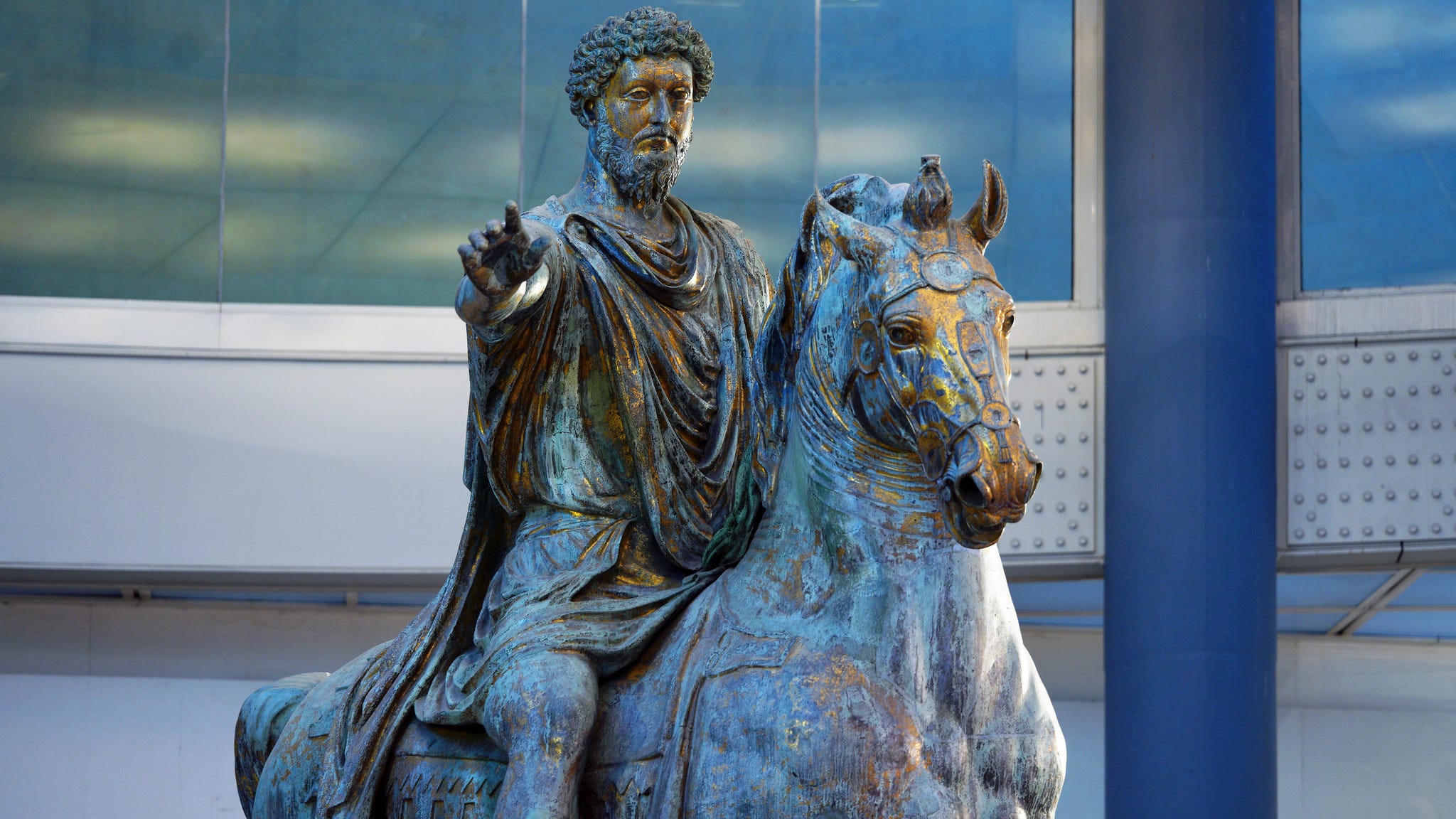
“Meditations” is a philosophical notebook the emperor Marcus Aurelius kept for reasons of personal improvement. In it, he reveals intimate and unflattering details about himself. What’s more, the tone of it is private, like the tone of a diary. He no doubt did not intend it to be published. “Meditations” is remarkable and sui generis: it preserves one man’s day-to-day work to become a perfected Stoic. We get to see Marcus’ thoughts both in the moment and upon reflection. Each entry is meant to bring him closer to the great Stoic goal: living in harmony with Nature.
To Stoics, Nature is the living system of the universe. Marcus describes it as a whole made up of subservient parts such as individual human beings and material objects. Though this gestalt is not fully personified in Meditations, Marcus does deem it worthy of prayer. Seen as a conglomerate, Nature is a perfect system. What it creates is good both for itself as a whole and for the individuals that make it up. It operates as change, everything from the change that movement causes to the transformation that we undergo at death. It is perpetually recycling decay into fresh creations.
Our duty to live in accordance with Nature means, among other things, accepting whatever it brings about for us in our lives. We should want to be in accord with it because it is fully good and does no harm to anyone or anything. If we think it has done harm, we are mistaken. Nature can, say, destroy your house with a tornado, but that’s not real harm. In Marcus’ strict construction of Stoic anti-materialism, all material things are equally irrelevant. The destruction of the house, an “object of indifference,” is neither good nor bad. Even one’s own death is neither good nor bad.
In the four entries that follow, Marcus exhorts himself to scorn material things and accept what happens to him without complaint. In each entry he addresses a “you” (himself). This “you,” though, ends up performing a bit of legerdemain. It is open and accommodating of people other than Marcus. One can’t help but take that “you” as referring to oneself. Hence comes the work’s remarkable ability to welcome readers in and take them on a journey of self-improvement. That ambiguous “you” is what has made Marcus’ private philosophical notebook a popular self-help book.
In entry 4.48 Marcus confronts his mortality. To recognize the transience of things, he encourages himself to contemplate not just the death of people and the destruction of material objects, but the obliteration of whole cities, such as Pompeii and Herculaneum. The implication is that the person who dismisses such ephemera will be free to live in harmony with Nature. In a poetic flourish Marcus concludes this entry by “transfusing” an olive and a Stoic sage in such a way that the olive is personified. It expresses blessings and gratitude. In entry 4.49 Marcus gives himself advice on how to handle perceived misfortunes. First, he should stand firm against them like a rocky headland beaten by the surf. Second, he shouldn’t perceive such events as misfortunes in the first place. They can only be good because they come from Nature.
Entry 4.50 involves a mental exercise meant to discourage Marcus from clinging to his life. He contemplates the lives of men who lived a long time in order to drive home the point that they didn’t experience anything more or better than those who died young. He admits to himself that a human life is difficult and, in the end, all but inconsequential so that he will no longer desire to hold on to his own. In entry 4.51 Marcus uses the metaphor of a journey to plot, in a geographical way, his movement toward living in harmony with Nature. Pursuing that goal leads toward rational and virtuous action and away from irrationality and vice.
Translating “Meditations” was a very pleasant process. Given the originally private nature of the notebook, the work felt especially intimate. Sometimes, in fact, I felt like I was Marcus’ shrink. Day in, day out, his exercises were my exercises. His relentless earnestness came to endear him to me. His words flash with the fire of the true believer.
Excerpts from Book 4 of “Meditations”
48
Keep calling to mind the fact that all these sorts of people have died in the past:
doctors who furrowed their brows over the ailing,
astrologers who made a big show of predicting the death dates of others,
philosophers who made innumerable statements about death and immortality,
heroes who slew multitudes,
tyrants who, with appalling arrogance, acted like gods as they abused their power over others.
And there are whole cities that are, in a manner of speaking, dead: Helice, Pompeii, Herculaneum, and countless more. Think also of how people you know have started dying off, one by one. You bury other people, die, and then other people bury you, and all in a wink.
To sum up, disdain the things that all humans experience—they are transient and without value. What yesterday was a glob of ejaculate tomorrow will be a mummy or cremains. Just move through your moment alive in harmony with Nature, and you will meet your end gratefully, as a ripe olive falls, blessing the soil that gave it existence and thanking the tree it grew on.
49
Be like a headland on which waves are constantly breaking: It stands firm and stops the seething.
I’m so unlucky. Something bad has happened to me.
That’s nonsense. It’s:
“I’m fortunate. Despite that recent occurrence, I remain unhurt. The present cannot break me, and the future holds no threat.”
Whatever “bad” thing has happened to you could have happened to anyone, but few would have remained unhurt by it. Why was it a misfortune and not good fortune, anyway? Do you regularly consider a perceived “misfortune” anything other than a rift with your human nature? And don’t you think a rift with that nature runs contrary to the will of that nature? And now you know what that will is.
Can that “bad” thing that happened to you keep you from being just, magnanimous, self-controlled, prudent, circumspect, forthright, modest, independent, and endowed with all the other virtues by which man’s true nature comes into its own? Whenever some occurrence starts leading you to a feeling of hurt, call this precept to mind, and heed it: If you nobly bear what at first seemed a misfortune, you become fortunate.
50
Though not properly philosophical, it is still useful when it comes to scorning death to contemplate the men who held on to life for a long, long time. What more did they get than the ones who went early? They all wound up dead eventually—Cadicianus, Fabius, Julianus, Lepidus, and all the other holdouts who buried many before their graves were dug.
A lifespan is a trifling interval, and you, with your flimsy body, must go to such great trouble with such difficult people. And a life ends up not amounting to much. Go ahead, look back at past time gaping infinitely behind you. Then turn around and see the future before you, another unbroken expanse. Given the way things are, is it really any better to live for three full human generations instead of just three days?
51
Take the direct route, the one that follows Nature and leads to sound reason ruling everything you say and do. A life journey like that takes you away from torment, reluctance, cunning, and pretentiousness.
Aaron Poochigian earned a PhD in Classics from the University of Minnesota and an MFA in Poetry from Columbia University. His poetry collection, American Divine, came out in 2021, followed by his immersive tour in verse, Four Walks in Central Park, in 2025. He has been the recipient of the Richard Wilbur and Anahid literary awards. Numerous translations of his have come out with Penguin Classics and W.W. Norton, including Sappho: Stung with Love and Marcus Aurelius’ Meditations. His work has appeared in such publications as Best American Poetry, The Paris Review and POETRY.
Join the Paideia Institute on Sunday, March 15th at 12:00pm ET for a free online lecture with Aaron Poochigian on his new translation of Marcus Aurelius' "Meditations". RSVP here.