

Amaryllis, Cheesemaker
by Catherine Connors

A love story grounded in women's labor.
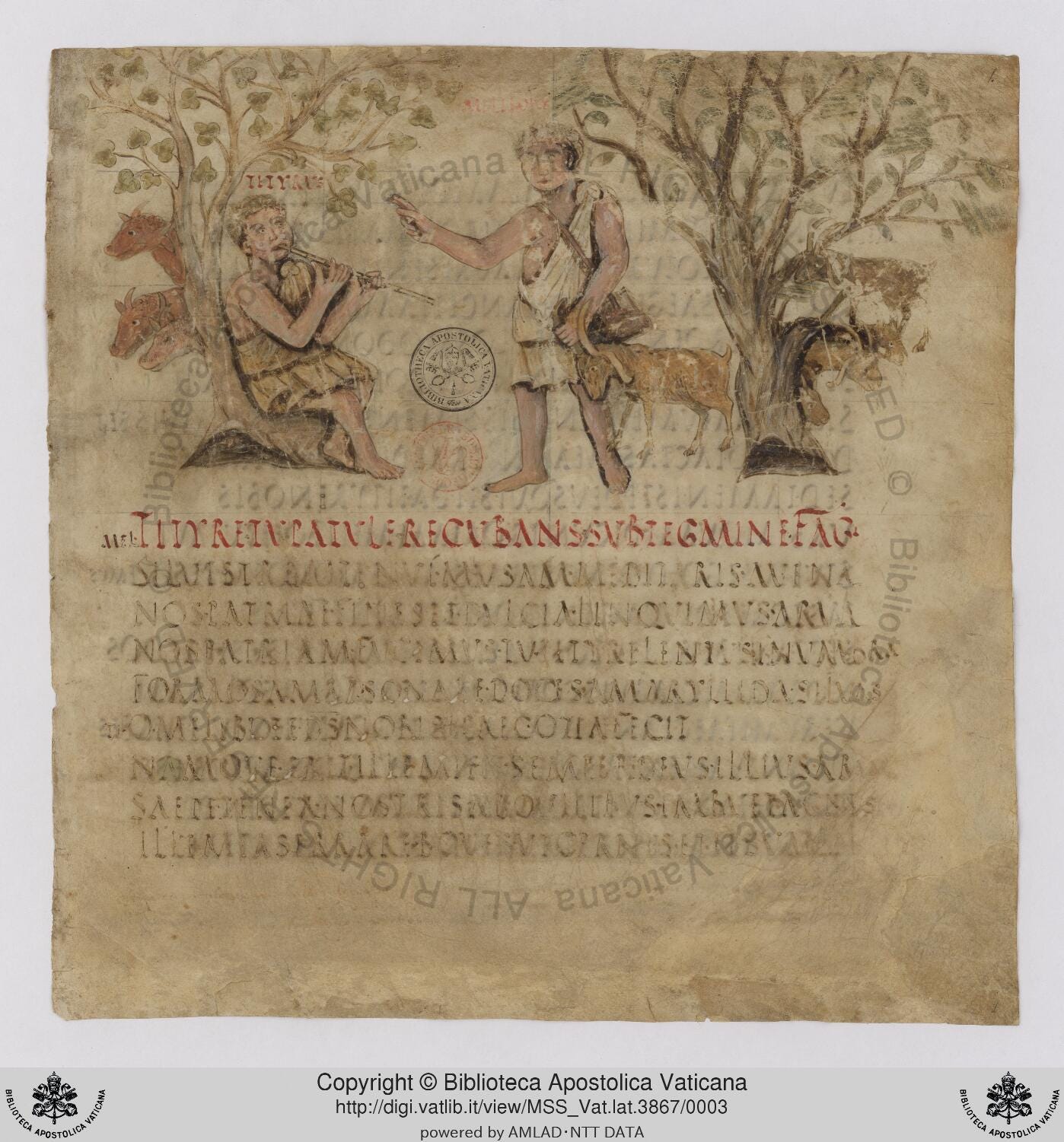
In Virgil’s first Eclogue (after 42 BCE), two herdsmen sing to each other against a background ripped from the headlines of Rome in Virgil’s own lifetime. The poem also incorporates a love story grounded in the work women do that makes households sustainable.
After Octavian and Antony defeated Brutus and Cassius at the battle of Philippi in 42 BCE, local inhabitants were driven out of lands in the Po Valley so that soldiers could be allotted farms. On the road in search of a new home, Virgil’s Meliboeus meets Tityrus, a herdsman composing songs about his beloved Amaryllis.
Tityre, tu patulae recubans sub tegmine fagi
silvestrem tenui Musam meditaris avena;
nos patriae fines et dulcia linquimus arva.
nos patriam fugimus; tu, Tityre, lentus in umbra
formosam resonare doces Amaryllida silvas. (Ecl. 1.1-5)Tityrus, lying there protected beneath the spreading beech-tree,
with your delicate shepherd’s pipe you spend your time on the woodland Muse.
We abandon our dear fields and the boundaries of our native land.
We flee our country; you, Tityrus, relaxing in the shade,
instruct the trees to echo ‘lovely Amaryllis’.
Virgil imports the singing shepherd from the Idylls of the Hellenistic poet Theocritus. In Idyll 3, the speaker entrusts his herd to Tityrus and sings insistently to Amaryllis of his love – all while she in her cave ignores him. Virgil places all of this amidst the turbulent events of his own place and time. The main thrust of Virgil’s poem is that Tityrus is doing well because An Important Man at Rome - who must be Octavian- has seen to it that he can keep his land and keep making songs for Amaryllis. Tityrus praises her not only for being ‘lovely’ (formosam) but, apparently, for how she (unlike his previous spendthrift beloved Galatea) helped him make his herds and cheese business sustainable, thus making it possible for him to purchase his freedom.
Libertas, quae sera tamen respexit inertem,
candidior postquam tondenti barba cadebat,
respexit tamen et longo post tempore venit,
postquam nos Amaryllis habet, Galatea reliquit.
namque (fatebor enim) dum me Galatea tenebat,
nec spes libertatis erat nec cura peculi.
quamvis multa meis exiret victima saeptis,
pinguis et ingratae premeretur caseus urbi,
non umquam gravis aere domum mihi dextra redibat. (Ecl. 1. 28-36)Because I was idle, Freedom turned to me late, when
graying hair fell as I got my beard trimmed.
Still, she turned and came to me after such a long time,
after Amaryllis took me and Galatea left me.
For I admit it, while Galatea possessed me,
I had no hope of freedom, nor thought about any private savings.
Although many a sacrificial sheep left my pens
and many a rich cheese was made for the ungrateful town,
never did my right hand return home heavy with cash.
Meliboeus then puts two and two together, recalling how Amaryllis left off apple picking and filled the countryside with an echoing lament while Tityrus was off in Rome asking for help:
Mirabar quid maesta deos, Amarylli, vocares,
cui pendere sua patereris in arbore poma;
Tityrus hinc aberat. Ipsae te, Tityre, pinus,
ipsi te fontes, ipsa haec arbusta vocabant. (Ecl. 1. 37-40)Amaryllis, I wondered why you prayed to the gods so sadly,
and for whom you let the apples hang in their trees;
Tityrus was gone. And Tityrus, the pines themselves,
the very springs and the orchards were calling out for you.
Tityrus’ celebration of both Amaryllis’ beauty and her labors is striking. Women’s work, that is, their importance to a sustainable household, is not commonly acknowledged in this way in the Greek and Roman ancient sources.
Another hardworking Amaryllis appears in Longus’ Greek novel Daphnis and Chloe, written during the second century CE. Set on the island of Lesbos, it tells the story of how the young and naive Daphnis and Chloe learn about love and become able to establish a sustainable home. Taking something of a fanfiction approach to the love poems of Sappho of Lesbos, Longus recalls her famous lines on the beauty of the apple the workers could not reach (Fr.105a) when Daphnis picks the last apple on a tree for Chloe (3.34). Longus also borrowed elements of country life and song from Theocritus. Daphnis’s father sings the song of Pan’s pursuit of Syrinx and her transformation into the reeds and panpipes claiming to have heard it from “a Sicilian goatherd,” Longus’ knowing wink at Theocritus’ reputed Sicilian origins (2.33).

Longus also seems to engage in fanfiction directed at another Hellenistic poet, Philetas, whose work is now mostly lost. When Daphnis and Chloe cannot understand the feelings of love that are overtaking them, they meet an old man named Philetas, who tells them how Eros (Love) appeared to him in his garden and told him he was “shepherding” Daphnis and Chloe to bring them together. Eros also reveals to Philetas that it was he who made it possible for Philetas to win his beloved wife Amaryllis: “I gave her to you, and now you have excellent sons who are herders and farmers” (2.3). We don’t know how the real poet Philetas might have represented Amaryllis; I enjoy speculating that he too might have celebrated her work as well as her beauty, and that this was the inspiration for Virgil’s lovely and hardworking Amaryllis.
It takes a Jane Austen-ish amount of time for Longus’ young lovers to find their path to marriage. Abandoned as infants and raised in separate households by enslaved parents on a country estate, Daphnis and Chloe are companions from childhood and they each help support their families by excellently herding sheep and goats and making cheese. When Daphnis gets permission from Chloe’s father to marry her, he rushes to her with the joyous news and “kisses her as a wife” when he finds her “milking and making cheese,” (3.33), which seems to me the kind of thing Philetas’ Amaryllis would have been doing. For Longus, marriage is actually a lot like cheese: it is a culturally constructed technology for using labor to manage reproductive resources over time to create a lasting and pleasurable household.
In their optimistic celebrations of beautiful Amaryllis as cheesemaker and contributor to the household Virgil and Longus (and perhaps Philetas before them) probably reinforce rather than critique the dominant structures of patriarchy and slavery. Still, their pictures of marriage as a partnership offers unexpected glimpses of romance from centuries ago.
Catherine Connors is Daniel P. Harmon Professor of Classics at the University of Washington, Seattle. She has written recently about Proba and about Lydia Maria Child’s Philothea (1836), a novel of Classical Athens.